01
Challenge
Live events are rarely managed in one place. Ticketing may handle the transaction, but the real operational work lives across planning docs, WhatsApp groups, payment tools, access lists, team coordination, vendor updates, and backstage workflows.
Oncor needed to become more than a ticketing product. The goal was to create a connected platform that could support audience-facing bookings while giving event teams clearer visibility across planning, access, logistics, activations, and delivery.
02
Approach
We approached Oncor as a full product ecosystem rather than a campaign site or simple booking tool.
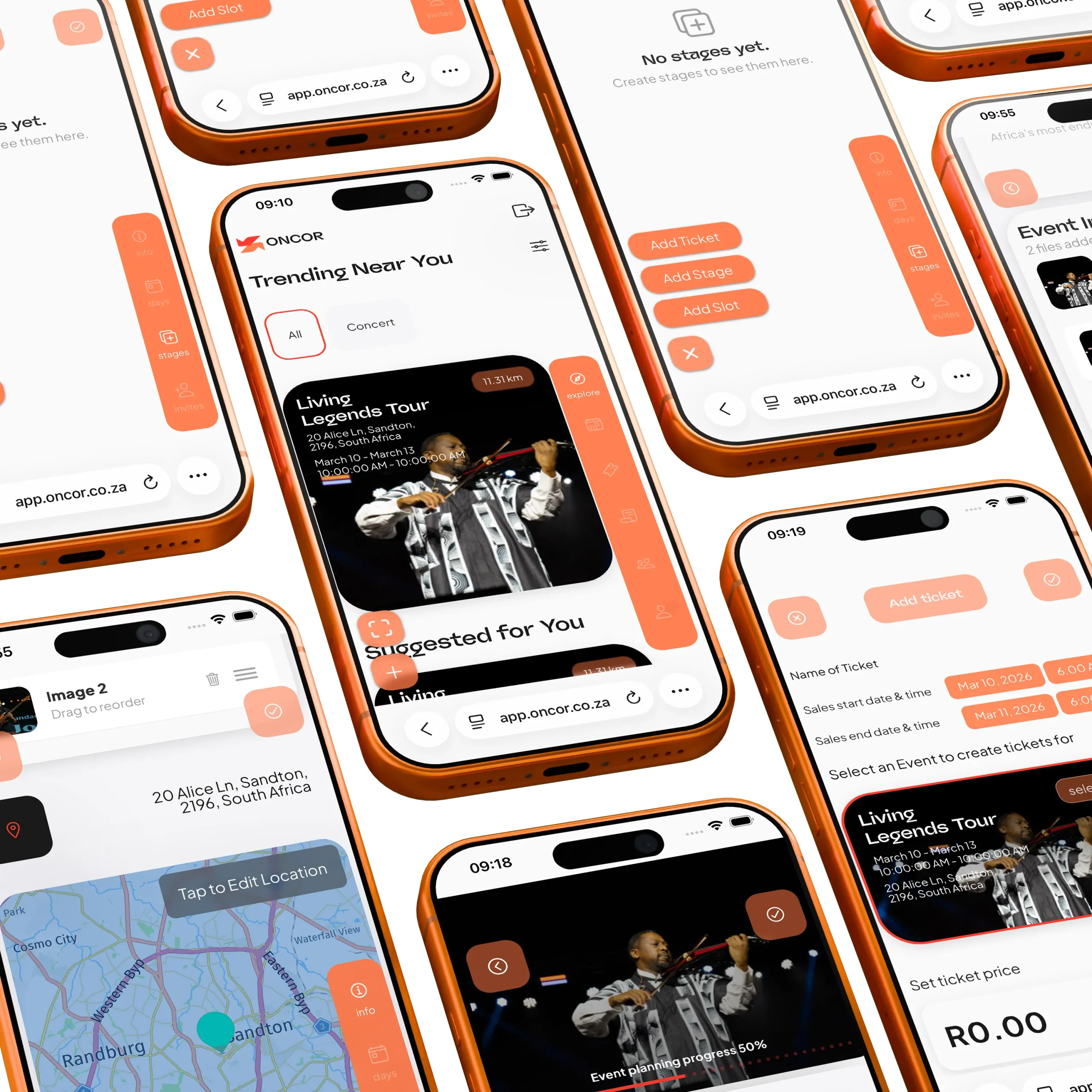
The platform was shaped around the operational reality behind live experiences: discovery, event setup, ticketing, team roles, venue structure, access control, payments, invites, and event-day visibility.
On the frontend, the product was built as a mobile-first Ionic and Angular app. On the backend, a Go service powers the core event infrastructure, using PostgreSQL and PostGIS for geospatial data, GORM for persistence, JWT authentication, Supabase storage, PayFast payment flows, and QR-based ticket logic.
03
Outcome
Oncor now has the foundation for a scalable event operations platform that moves beyond traditional ticketing.
The product supports event discovery, planning, ticket management, access workflows, payments, stakeholder coordination, and future utility layers such as rewards, activations, and TNG-based payment use cases.
It gives the platform a stronger technical base and a clearer market position: one operational layer for live experiences, from bookings to backstage.
01
Platform Positioning
We clarified Oncor around a stronger product idea: not just ticketing, but a connected operational layer for live events, covering bookings, access, teams, activations, and backstage execution.
02
Mobile App Experience
The app was built with Ionic and Angular to support mobile-first event discovery, event management, ticket access, planning sections, transactions, rewards, settings, and role-based user flows.
03
Backend Infrastructure
A Go backend was developed with Fiber, GORM, PostgreSQL, PostGIS, JWT authentication, Supabase storage, PayFast payment logic, QR ticketing, invites, orders, transactions, venues, spaces, slots, and geolocation-aware event discovery.
04
Operational Roadmap
The platform was structured to grow from core event operations into broader use cases around partner activations, rewards, digital utility, TNG payments, and deeper event-day coordination.